
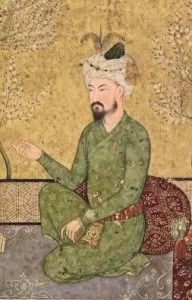
Who Was the First Mughal Emperor? The Untold Story of Black Powder, Bloodlines, and Babur
Imagine being stripped of inherited rule by the age of twelve, surviving as a landless refugee in Central Asia’s cold mountain passes, and eventually creating an empire that would dominate over 150 million people.
The first Mughal emperor was who? Zahir-ud-din Muhammad, often referred to throughout history as Babur (meaning “The Tiger”), is the simple answer. Babur created the Mughal Empire in 1526 after breaking thru the Hindu Kush and defeating the Delhi Sultanate’s numerical superiority. This dynasty changed the political, architectural, and cultural landscape of the Indian subcontinent for more than three centuries.
However, the real story of how a young prince from Fergana became one of the greatest empires in history goes much beyond straightforward battle dates.
Fact Category,Details
Full Name, Zahir-ud-din Muhammad Babur
Born / Died, ” February 14, 1483 (Andijan, Fergana) – December 26, 1530 (Agra)”
Ancestry, Timurid (Patrilineal: 5th-gen from Timur) & Mongol (Matrilineal: 13th-gen from Genghis Khan)
Reign as Mughal Emperor, “April 20, 1526 – December 26, 1530”
Key Victories, “First Battle of Panipat (1526), Battle of Khanwa (1527), Battle of Ghaghra (1529)”
Primary Autobiography, Baburnama (Chagatai Turkic)
Successor, Nasir-ud-din Muhammad Humayun (Son)
- Royal Bloodlines: The Timurid and Mongol HeritageTo understand Babur, you must look at his DNA. He was born into the ultimate conqueror lineage: Father’s Side: Direct descendant of Timur (Tamerlane), the Turkic conqueror who laid waste to Central Asia and northern India. Mother’s Side: Direct descendant of Genghis Khan, the legendary Mongol ruler. Ironically, Babur hated being called a “Mughal” (a Persian derivative of “Mongol”). He identified strictly as a Turkic Timurid prince, speaking Chagatai Turkic and holding high regard for Persian court culture.
- From Homeless Prince to Sovereign of Kabul: Babur’s journey to build an empire was paved with adversity: Loss of Fergana (1494–1504): Babur, at eleven years old, acquired the minor principality of Fergana (in present-day Uzbekistan) upon the unexpected death of his father. Babur spent his adolescent years as a fugitive after being betrayed by competing princes and expelled by the Uzbek leader Shaybani Khan. The Conquest of Kabul (1504): Refusing to give up on his desire to become an emperor, Babur crossed the Hindu Kush with a few hundred devoted warriors and took control of Kabul (Afghanistan). For more than twenty years, Kabul was his strategic base. Babur moved his attention southward toward the wealth of Hindustan (Northern India) after realizing that the growing Uzbek dominance had cut off Central Asia.
- The First Battle of Panipat, the turning point of 1526
Babur marched onto the Panipat plains in April 1526, around ninety kilometers north of Delhi. The Sultan of Delhi, Ibrahim Lodi, had an army of more than 100,000 soldiers and 1,000 war elephants waiting for him. There were just 12,000 to 15,000 soldiers in Babur’s army.
Hindustan’s Winning Strategic Innovations:
Matchlocks and Field Artillery: Babur brought gunpowder artillery to northern India on a never-before-seen scale with the help of Ottoman cannon expert Ustad Ali Quli.
The Ottoman Rumi Tactics: He protected his gunners while creating fire gaps by chaining hundreds of wooden carts (araba) together to create a rolling defense wall.
The Tulughma Flanking Maneuver: Lodi’s enormous army was surrounded by well-trained horse archers from the rear and sides, forcing them within their own artillery range.
Babur proclaimed himself Emperor of Hindustan at Agra, the Delhi Sultanate fell, and Ibrahim Lodi was killed on the battlefield.
- Strengthening the Empire: Khanwa & Ghaghra’s victory in Delhi was just the beginning. Babur had to vanquish two strong, established power blocs in order to secure his precarious empire:At the Battle of Khanwa (1527), Mewar’s Rana Sanga led a powerful coalition of Rajput kings in a march to drive Babur out. Babur gathered his exhausted soldiers in the face of an overwhelming force, vowed to abstain from wine, and used his superior tactical formations to win handily. At the Battle of Ghaghra (1529), Babur took total control of the Gangetic plains by crushing the last Afghan confederacy along the banks of the Ghaghra River.
- Babur’s Legacy: Beyond the Battlefield
Babur was a brilliant Renaissance man who established the Mughal dynasty’s cultural model, not just a warrior.
MUGHAL DYNASTY FOUNDATION
┌───────────────────┴───────────────────┐
▼ ▼
MILITARY GENIUS CULTURAL LEGACY
• Artillery & Tulughma Tactics • Baburnama Autobiography
• Victor at Panipat & Khanwa • Persianized Court Culture
• Consolidated Northern India • Charbagh Garden Architecture
The Baburnama: The Islamic World’s First Authentic Biography
Babur wrote his personal memoirs (Baburnama) in open and exquisite Chagatai Turkic, in contrast to typical court records meant to appease kings. He documented his military failures, noted the flora and fauna of India, wrote poetry, and openly discussed his personal struggles.
Charbagh Gardens’ architectural blueprint
Babur brought the formal Charbagh (four-quadrant garden) design, with its beautiful canals, tiered fountains, and shaded orchards, to India because he was homesick for the cold streams of Central Asia. Future Mughal architectural wonders like the Taj Mahal were made possible by this style.
Common Questions
If the empire was little at the time of Babur’s death,
why is he referred to as the first Mughal Emperor?Babur unified the key territories (Delhi, Agra, Punjab, Jaunpur), instituted royal military technology, and created the ultimate sovereign power. This basic state was further developed by his son Humayun and grandson Akbar.
Babur is buried where?
At the age of 47, Babur passed away in Agra in 1530. His body was then transferred to his cherished gardens in Afghanistan, Bagh-e Babur (Gardens of Babur) in Kabul, in accordance with his final desires.
The Persian name for Mongol is whence the word “Mughal” originated. Although Babur’s court preferred to refer to themselves as Gurkani (in-laws of Timur), European travelers and Indian contemporaries used it to indicate the ruler’s Chinggisid (Genghis Khan) heritage.
In conclusion,
Zahir-ud-din Muhammad Babur was a survivor, poet, naturalist, and brilliant military strategist in addition to being a military conqueror. He brought an end to the medieval sultanate era and established the Mughal Empire by combining horse archers from Central Asia with contemporary Ottoman weapons.
The strategic basis for a golden age of art, architecture, and political domination that would shape South Asian history for hundreds of years was established during his four-year rule in India. Babur – Wikipedia
“हड़प्पा सभ्यता: खोज, विशेषताएँ और पतन”
https://link.amazon/B02PI2IOT





Leave a Reply